“Smog will contribute to the premature deaths of 2,700 Canadians, put 11,000 in hospital and produce a 1billion dollar cost to the economy and health care system.” –Canadian Medical Association, 2008
How Wind Works
Change is in the air. Wind power keeps improving in a big way. Advances in technology and soaring global energy costs are making wind power a clean and viable alternative for energy producers everywhere.
There’s a growing interest in wind across Canada. From major power producers looking for cleaner ways to produce energy for the grid to inventive companies searching for alternative ways to power their plants – even down to the individual who wants to live off-grid – it’s the people who believe in wind who power it.
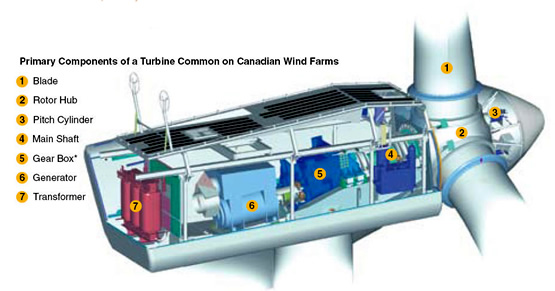
Wind turbine technology. The windmill has been used for millennia to grind grain. In the decades leading up to the 1930s, the wind turbine was used to generate electricity. Since the 1970s wind power, and the technology behind the modern turbine, has undergone a revolution.
The first modern turbines were larger than those of the 1930s and were grouped together to form wind farms for the purpose of generating electricity. First used in Denmark and California in the 1970s, the average output of a wind turbine back then was 100 kW. Today, that output is typically 20 times greater.
Today’s turbines are far more efficient machines. They sit higher up in the air affording them access to better wind resources and fewer obstacles. The materials used to build the blades are stronger and lighter, so turbines can be built bigger and cover a greater area as they spin, generating far more electricity with every sweep.
Offshore. In other parts of Europe, a smaller inventory of onshore sites has led to the development of offshore wind. Putting turbines offshore offers producers the opportunity of a stronger and steadier wind resource. As offshore sites are more expensive to build, turbines must be larger and more efficient. Bigger wind turbines are being developed in Europe to make the most efficient use of their offshore wind resource. In Canada, we are mainly focused on our onshore resource at this time, but some offshore projects are being pursued.
How Wind Works, Full Article (PDF 400kb) Content source is the copyright property of CANWEA and has been reproduced with permission.